Soliword: Solitaire Link Word
- 4.8
- Rating
- 10.00K
- Installs
- Free
- Price
 Analysis by App-foxy
I spent time with Soliword: Solitaire Link Word as a light word game built around arranging and matching cards through associations. Its central idea is easy to understand: you look for relationships between words while working through a solitaire-style layout. That combination gives it a calmer feel than a timed word search, but it still asks you to think carefully before making a move.
What I like most is how quickly the game explains itself through play. I did not need a long tutorial or a complicated rules screen to understand the basic rhythm. The first puzzles are approachable, and the early experience is mainly about learning how the word links behave, spotting useful pairs, and clearing the layout without rushing. For a free game in the word category, that gentle opening is a sensible choice.
LifePulse Puzzle Game Studio presents the game for everyone, and I can see why. The vocabulary-focused format is suitable for short sessions, quiet breaks, and players who prefer mental puzzles to fast reactions. It is available free of charge, although optional in-app purchases range from $1.99 to $99.99 per item. That makes the initial barrier low, while also giving players a reason to pay attention to how the game handles continued play.
You May Also Like

 Blood Strike: 2.5 Anniversary
Blood Strike’s Loadouts Turn Every Drop Into a Tactical Gamble
A close look at Blood Strike’s custom loadouts: how fast access to signature weapons reshapes its battle royale rhythm, rewards preparation, and narrows the gap between fights.

 Pandora - Music & Podcasts
Pandora’s Music Is Easy to Start, but Harder to Recover
Pandora’s strength is its low-effort path from a seed to a station. Its weak spot is how much confidence it asks you to place in connection, setup, and quiet recovery.

 8 Ball Pool
 Is Built on Rivalries, Rematches, and Routine
A close look at the rivalries, rematches, shared routines, and unanswered safety questions that turn a quick pool match into a persistent mobile community.

 Samsung Music
’s Quiet Strength Is Playing What You Already Own
Its reach comes less from spectacle than from dependable access to a personal library. That simplicity is both the app’s strongest retention engine and its ceiling.

 AccuWeather: Weather Radar
AccuWeather Review: A Quick, Clear Forecast for Everyday Decisions
For everyday plans, the best forecast is the one you can understand quickly. AccuWeather makes rain timing, radar, and local conditions easy to act on, with a few trade-offs.

 Hill Climb Racing
Why Hill Climb Racing Still Turns Crashes Into One More Run
A tiny car, a bumpy hill and one more upgrade: Hill Climb Racing keeps resurfacing because its simple chaos makes every near-miss feel personal.
More From Our News Desk
View All News


How the early goals shape the first sessions
The first useful goal is simply learning to read the board. In a regular solitaire game, the main question is often which card can be moved next. Here, I found myself asking a second question: which words belong together, and does using that connection help expose the next useful option? That extra layer makes each move feel more deliberate than tapping through an obvious card sequence.
This design is friendly to newcomers because the objective is concrete. I am not trying to master a large collection of unrelated modes. I am trying to sort and connect words well enough to make progress through the current puzzle. The simplicity also makes the game easy to recommend to someone who enjoys word associations but does not want a traditional crossword or a demanding competitive word app.
A practical way to approach the opening boards is to avoid committing to the first connection that looks possible. I had better results when I scanned the whole layout first, looking for words that seemed to have more than one possible relationship. Using a flexible word too early can leave a less obvious match stranded later. This is a small but important shift: the game rewards planning more than speed.
That early decision-making is one of the title's strongest ideas. The solitaire structure gives the wordplay a visible shape, so mistakes are easier to understand. Instead of feeling as though I missed a hidden answer in a blank grid, I could usually identify the card or association that had narrowed my options. That clarity makes the learning process less frustrating.
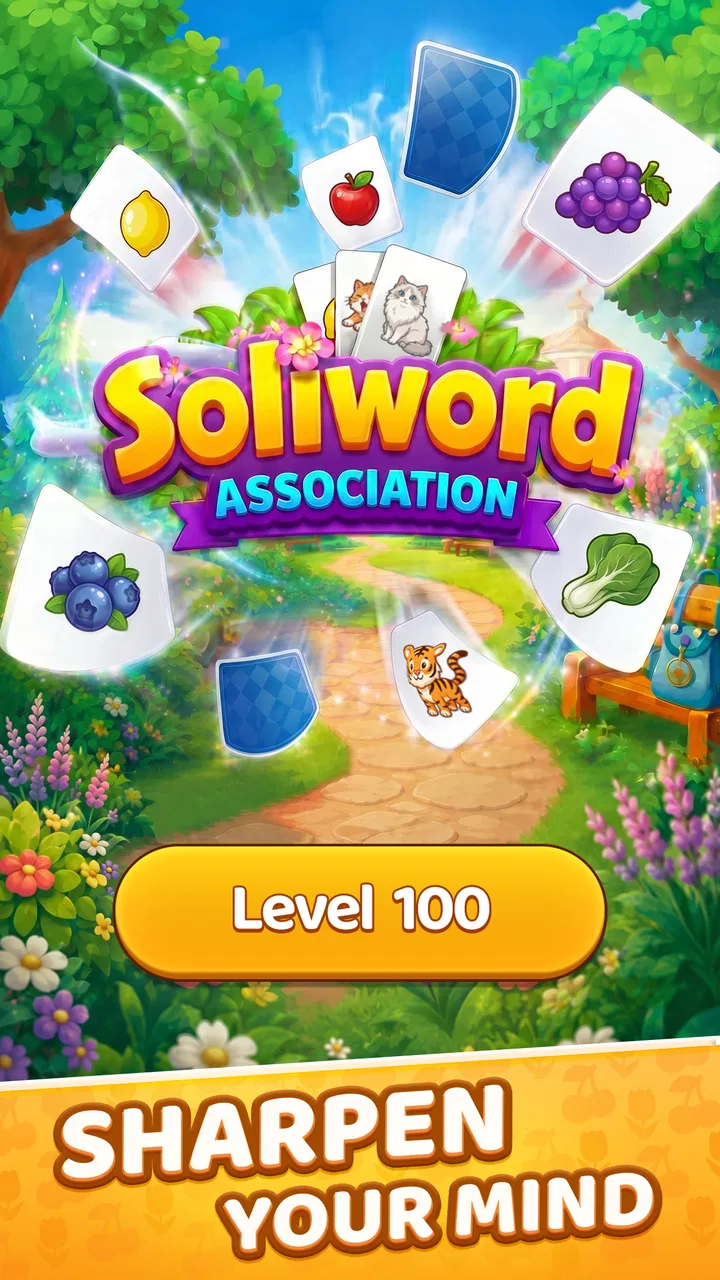
The short-description label is simply “Soliword,” while the fuller concept communicates more about the experience. In practice, I would describe it to a friend as a word-association solitaire game rather than as a conventional card game with a vocabulary theme. The cards are the framework; the real challenge comes from recognizing connections and preserving a workable route through the puzzle.
What counts as progress while playing
The game’s progress signals are more immediate than long-term. Clearing a useful group of cards, uncovering a new word, or finding a connection that opens the board all provide a clear sense that a decision worked. I appreciated that feedback because it keeps the focus on the puzzle in front of me instead of requiring a complicated progression system to make every session feel worthwhile.
This also means the game is best understood as a sequence of small mental victories. A successful move may not look dramatic, but it changes the available board and gives me more information. When I was stuck, I could often improve my position by reconsidering the order of my moves rather than searching for an entirely different strategy.
One useful habit is to treat newly exposed cards as information, not just as new tasks. When a card appears, I look at how it affects several possible links before acting. If it creates a strong connection, I may use it immediately. If it is ambiguous, I keep it in mind and work with more certain matches first. This approach reduces unnecessary dead ends and makes the puzzle feel more controlled.
Another tip is to separate recognition from commitment. I might notice that two words belong together, but that does not automatically mean they should be matched at once. In a layout where one word can support multiple routes, waiting a move can reveal whether that connection is genuinely useful. This is the kind of small tactical choice that is easy to miss in the store summary but matters during actual play.
The rating shown for the game is a 4.8 average from around 164 ratings, and its reach is currently over 10K installs. Those figures suggest that the basic concept has found an audience, but they do not replace personal preference. I would not choose this game for a large social community or a highly competitive ladder. I would choose it for the focused satisfaction of solving one word-based layout at a time.
Difficulty: from recognition to restraint
The difficulty curve works best when the game asks me to move from obvious associations toward more careful interpretation. Early puzzles can teach the basic relationship between words and cards, while later situations naturally become more demanding when several plausible links compete for attention. The challenge is not only knowing words; it is deciding which known relationship is strategically safe.
That distinction gives the game more depth than a simple matching exercise. A player with a strong vocabulary may still make poor progress by acting too quickly, while a patient player can often compensate for not knowing every possible association immediately. I found that the most valuable skill was keeping options open and recognizing when a tempting move might reduce the board’s flexibility.
However, the same structure can create friction. If a player expects every answer to be literal or tightly defined, some associations may feel less satisfying than a standard dictionary-based puzzle. Word games depend heavily on how natural the connections feel, and personal vocabulary makes that experience uneven. A word that seems obvious to one person may take another player several attempts to interpret.
For that reason, I think the game suits people who enjoy language from different angles rather than players who want only strict spelling accuracy. It is a better fit for association puzzles than for those looking for a pure anagram challenge. If your favorite word games are built around exact definitions, letter counts, or crossword-style clues, this may feel more open-ended than you prefer.
The solitaire format also affects the pacing of difficulty. There is no need to race through a board, so I can pause and inspect the available choices. That is helpful when the puzzle becomes less obvious, but it can also reduce urgency. Players who need a timer, a live opponent, or a strong score chase may find the experience too quiet unless the puzzle itself is enough motivation.
Does the game sustain interest?
The main retention pressure comes from the desire to solve the next layout and improve the quality of my decisions. That is a healthier form of motivation for me than a constant stream of notifications or competitive demands. I can open the game during a short break, complete a focused puzzle, and stop without feeling that I have missed an important event.
At the same time, this relaxed structure will not appeal equally to everyone. Without a strong social layer or a fast competitive loop, long-term interest depends on whether the word associations continue to feel fresh. If I stop enjoying the act of scanning, comparing, and planning, there is not much else in the core concept to pull me back.
The free entry helps experimentation. I can try the basic experience before deciding whether it belongs in my regular rotation. The presence of optional purchases is worth keeping in mind, especially for players who prefer games with no spending prompts at all. I would approach those purchases cautiously and judge them by whether they improve convenience without becoming necessary for ordinary enjoyment.
For a realistic everyday use case, I can imagine playing during a commute while waiting for an appointment, or taking a few minutes away from a busy workday. The game’s word-and-card format is well suited to that setting because it does not require a long explanation each time I return. I can inspect the current layout, identify the most promising connections, and continue at my own pace.
It is less suitable when I want something to fill an entire evening with constant variety. In that situation, a larger word-game collection, a crossword app with many puzzle types, or a traditional solitaire game with several variants may offer more breadth. Soliword’s appeal is narrower and more focused: its identity comes from combining association thinking with solitaire progression.
Who should play, and who should skip it
I would recommend it to players who enjoy calm puzzle sessions, word relationships, and games that reward looking ahead. It is especially approachable for someone who finds conventional solitaire too repetitive but does not want the pressure of a timed word challenge. The everyone age rating also makes its presentation broadly accessible, though individual enjoyment will still depend on vocabulary and tolerance for less literal connections.
I would be more cautious recommending it to players who want a clear campaign with elaborate unlocks, character development, or a visible collection system. The appeal here is the puzzle loop itself. If you need a large progression framework to maintain interest, this may feel modest. Likewise, players who dislike optional purchase systems should consider whether a free-to-start game with item prices from $1.99 to $99.99 fits their habits before investing much time.
It is also not the best choice for someone seeking educational vocabulary training with structured definitions and measurable lessons. The game encourages association and planning, but I would not treat it as a replacement for a dedicated language-learning tool. Its purpose is entertainment first, with mental exercise arriving naturally through the card layouts.
On Android, the listed minimum operating system is Android 8.0, so owners of older devices should check compatibility before planning to use it. The current version is 1.0.9, which places the review in the context of a relatively early release stage. That makes the focused design understandable, but it also means I would keep expectations realistic about the size and maturity of the overall experience.
My verdict on the progression and pacing
Soliword succeeds when it lets a small decision matter. The early goals are clear, the board itself provides useful progress signals, and the difficulty comes from choosing the right association at the right moment rather than from artificial speed. I found the pacing comfortable for short sessions, with enough planning to prevent the game from becoming a completely automatic matching exercise.
Its limitations are tied to the same focus. The experience may feel too restrained for players who want multiple modes, deep unlock paths, or constant competitive pressure. The open-ended nature of word connections can also produce occasional uncertainty, and the free-to-start model means I would pay attention to how optional purchases fit into my personal play style.
Still, as a compact word game from LifePulse Puzzle Game Studio, it has a clear personality. I would keep it installed for quiet moments when I want to think without being rushed. The best reason to try it is the satisfying trade-off between finding a clever word link and preserving enough options to finish the layout. If that kind of measured puzzle decision sounds appealing, the free starting point makes it easy to test. If you need a broad progression system or a more energetic challenge, a traditional crossword collection or competitive word game will probably serve you better.
My final recommendation is positive but specific: try it for its association-based solitaire loop, not because it promises to replace every other word or card game. When approached on those terms, it offers a pleasant, accessible way to turn a few spare minutes into a focused mental break.
FAQs for Soliword: Solitaire Link Word
01What is Soliword: Solitaire Link Word and how does it work?
Soliword: Solitaire Link Word is a unique blend of solitaire and word puzzle games. The gameplay involves linking letters to form words while strategically playing solitaire-style card games. This combination challenges both your vocabulary and strategic thinking skills, providing an engaging and refreshing experience for casual gamers.
02Is Soliword: Solitaire Link Word free to play?
Soliword: Solitaire Link Word is free to download and play, but it offers in-app purchases. These purchases can enhance the gaming experience by providing additional hints or removing ads. While the game is fully enjoyable without spending money, some players opt for purchases to progress faster or eliminate interruptions.
03What are the minimum device requirements to run Soliword: Solitaire Link Word?
To enjoy Soliword: Solitaire Link Word, you'll need a smartphone or tablet with Android 5.0 or iOS 10.0 or later. The game is optimized for smooth performance on most modern devices, but ensuring your device's software is up-to-date will provide the best experience.
04Does Soliword: Solitaire Link Word offer any social features?
Yes, Soliword: Solitaire Link Word includes social features that allow you to connect with friends. You can compete on leaderboards or share your progress and achievements through social media. This adds a competitive edge and allows players to enjoy the game collaboratively.
05How does the difficulty progress in Soliword: Solitaire Link Word?
The game begins with easier levels to help players get accustomed to the mechanics. As you advance, the challenges become more complex, requiring a balance of strategic card play and word formation. This progression keeps the game engaging and ensures players are continually challenged.
Pros
- Engaging blend of solitaire and word puzzles.
- Daily challenges keep gameplay fresh.
- Simple interface easy for all ages.
- Offline mode available for travel.
- No intrusive ads during gameplay.
Cons
- Limited hints can be frustrating.
- In-app purchases for extra features.
- Graphics could be more vibrant.
- Word variety is sometimes limited.
- Occasional lag on older devices.

Soliword: Solitaire Link Word
Gallery